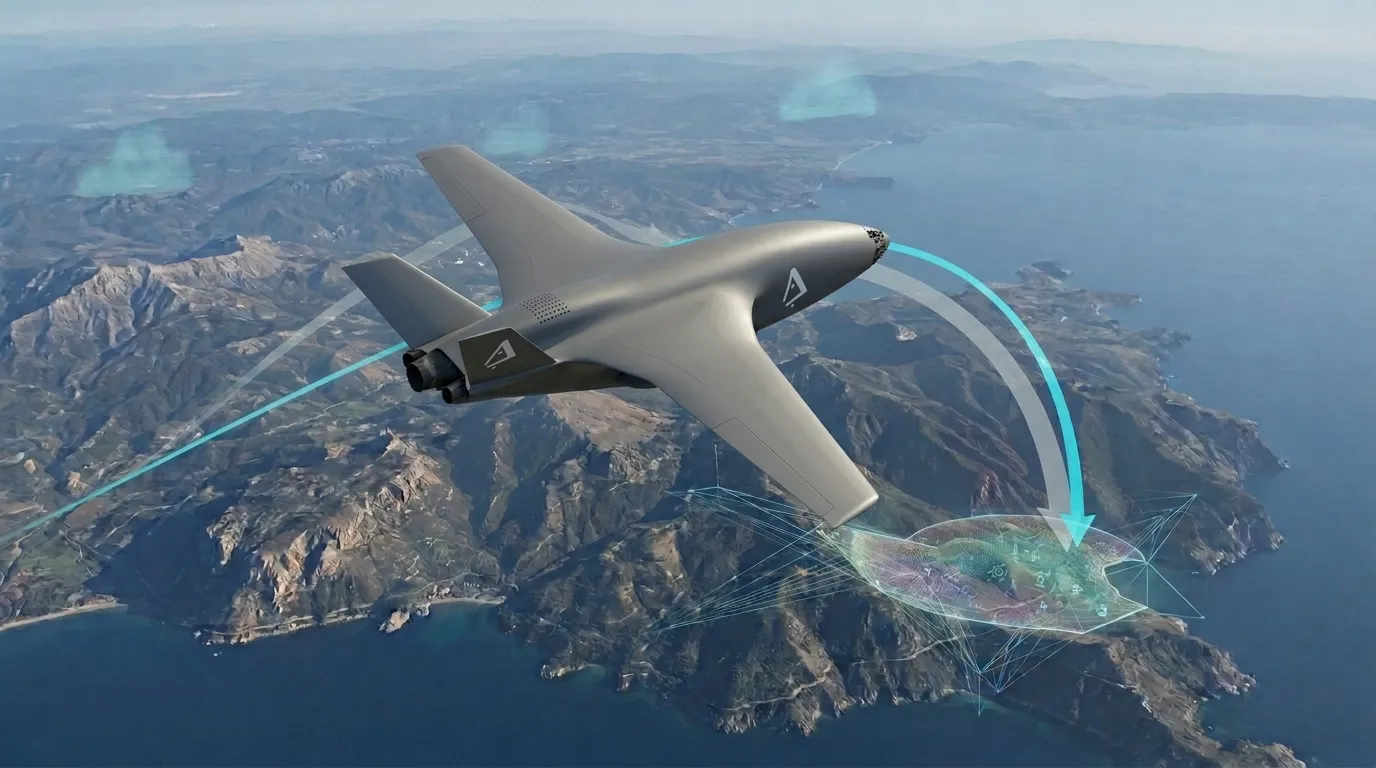
An autonomous group becomes much more complex than an individual unmanned vehicle. Each new participant adds not only another sensor or actuator, but also new relationships, possible roles, information exchange routes and options for joint behavior.
AERIS W-State Topology explores an architecture that treats coordination as a group-wide property. Instead of building a system around one permanent control center, a distributed collective state is formed, allowing participants to act as a connected autonomous system.
Problem of scale
For a small group of devices, coordination of actions can be constructed in a relatively straightforward manner. As the number of participants grows, the task changes qualitatively: the number of simultaneously occurring events, available options for action, and mutual dependencies increases.
In such a system, it is not enough to simply increase the volume of data exchange. It is necessary to maintain consistency in the group's behavior and not allow the complexity of coordination to grow faster than its actual capabilities.
Scaling is one of the main tasks of W-State Topology. The architecture is focused on working with groups, where many autonomous participants must make interrelated decisions in a common dynamic environment.
A collective state instead of a set of isolated solutions
If each device views the situation exclusively from its own point of view, the system constantly has to coordinate a large number of local decisions.
W-State Topology introduces another level of organization: in addition to the own state of individual participants, there is a state of the group, reflecting changes that are significant for the joint task.
Thanks to this, information can be considered not only as a message from one device to another, but also as a change in the current state of the entire autonomous group.
This approach allows behavior to be formed based not only on the interests of an individual participant, but also on the position of the group as a whole.
No permanent central hub
The architecture of a large autonomous group should not completely depend on one device constantly acting as a coordinator.
Centralization creates a scalability limitation and at the same time forms a critical point of the system. If such a node is lost, the group must either transfer control to another participant or significantly change the logic of its work.
In W-State Topology, coordination is initially built in a distributed manner. Individual devices remain independent participants, and information significant for the overall task is not tied to one permanent center.
- the group does not require one constant management apparatus;
- coordination is maintained when the relative position of the participants changes;
- the composition of the group may change during the execution of the task;
- the system is capable of redistributing functions between available participants.
Stability when group composition changes
A real autonomous swarm is not a static system. An individual device may temporarily lose the communication channel, leave the work area, complete its own part of the task, or become unavailable.
For a distributed architecture, it is important that such an event does not lead to the destruction of all collaborative logic.
W-State Topology is focused on incremental change in group capabilities. The loss of one participant may reduce the available sensor coverage, computing resource, or number of possible performers, but should not automatically terminate the work of the others.
Likewise, the arrival of a new member should enhance the capabilities of the system without the need to completely rebuild the mission manually.
Dynamic group
During a real flight, the relative position of the vehicles is constantly changing. Along with it, the availability of communication, the quality of observation, the energy state, the distance to the area of interest and the suitability of each participant for a specific task change.
Therefore, W-State Topology views the swarm as a dynamic structure rather than a predetermined formation.
At any given moment, different participants may have different values for the overall task. One is closer to the object of observation, the other has a suitable sensor, the third has a better communication channel, the fourth retains a larger energy reserve.
The architecture makes it possible to take into account changes in such conditions at the group level and rebuild joint behavior without being tied to a constant distribution of roles.
Scalable coordination
One of the most important areas of AERIS research concerns the behavior of the system as the number of autonomous participants increases.
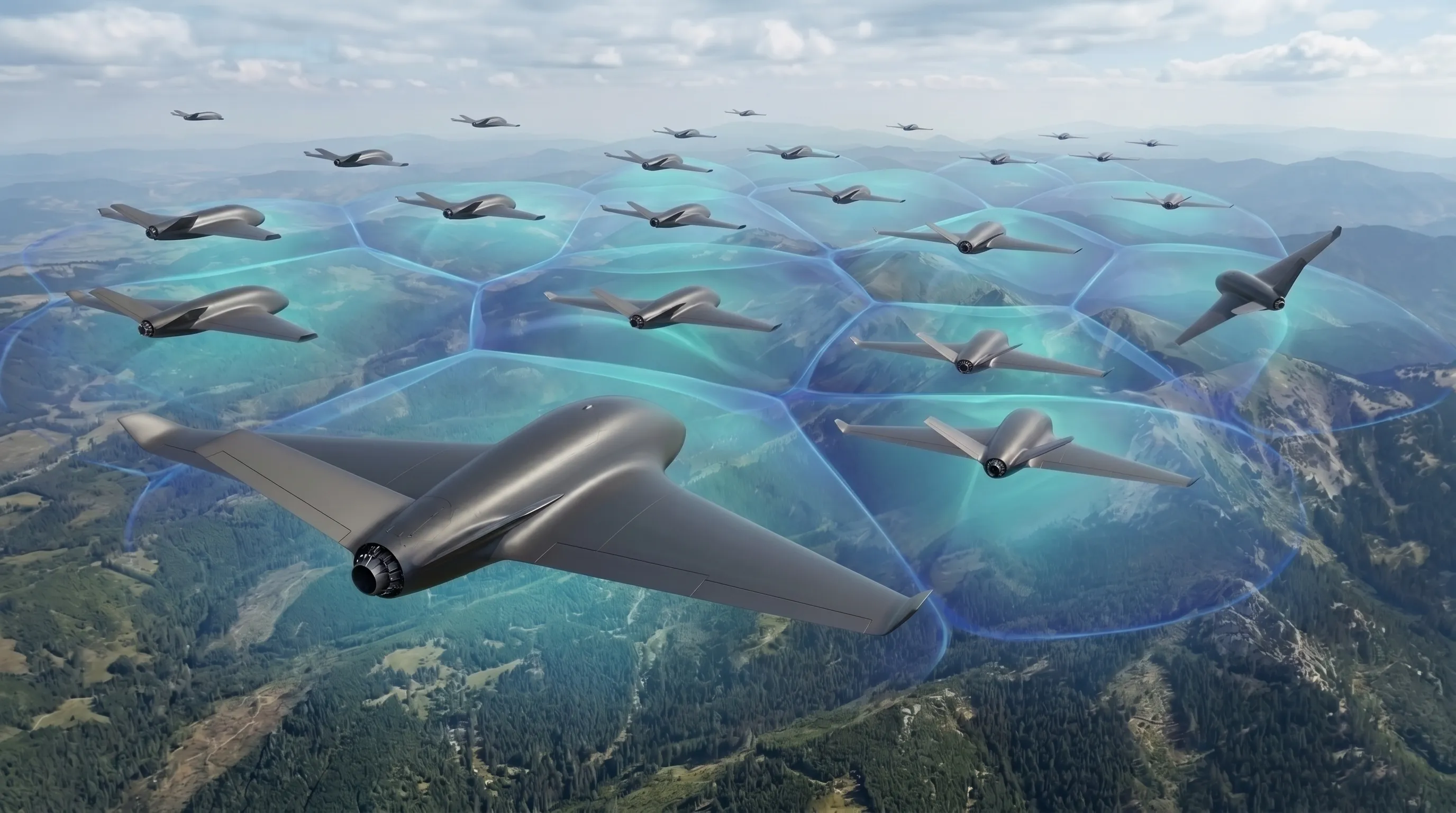
It is in large groups that the benefits of W-State Topology are most noticeable. As the swarm grows, the architecture allows it to maintain the distributed nature of coordination and work with a significantly more complex structure of joint behavior.
This is especially important for tasks in which devices simultaneously observe different areas, receive different information and must constantly take into account the actions of other participants.
In AERIS research, W-State Topology shows a pronounced advantage in the transition to large multi-agent systems, where traditional coordination schemes begin to face rapidly increasing complexity of interactions.
Not fixed roles, but a common task
For a predictable mission, roles can be defined in advance: one vehicle performs surveillance, another maintains communications, and the third follows a given route.
In a changing environment, this distribution quickly becomes a limitation. Conditions may change after the mission has begun, and the vehicle to which a particular function was assigned may no longer be the optimal performer.
W-State Topology allows you to build a system around the task itself, rather than around a constant set of assignments.
- participants can change function as the situation develops;
- the task can be redistributed between several devices;
- the group is able to continue working after changes in its composition;
- decisions are made taking into account the state of the entire available system.
Distributed perception of the environment
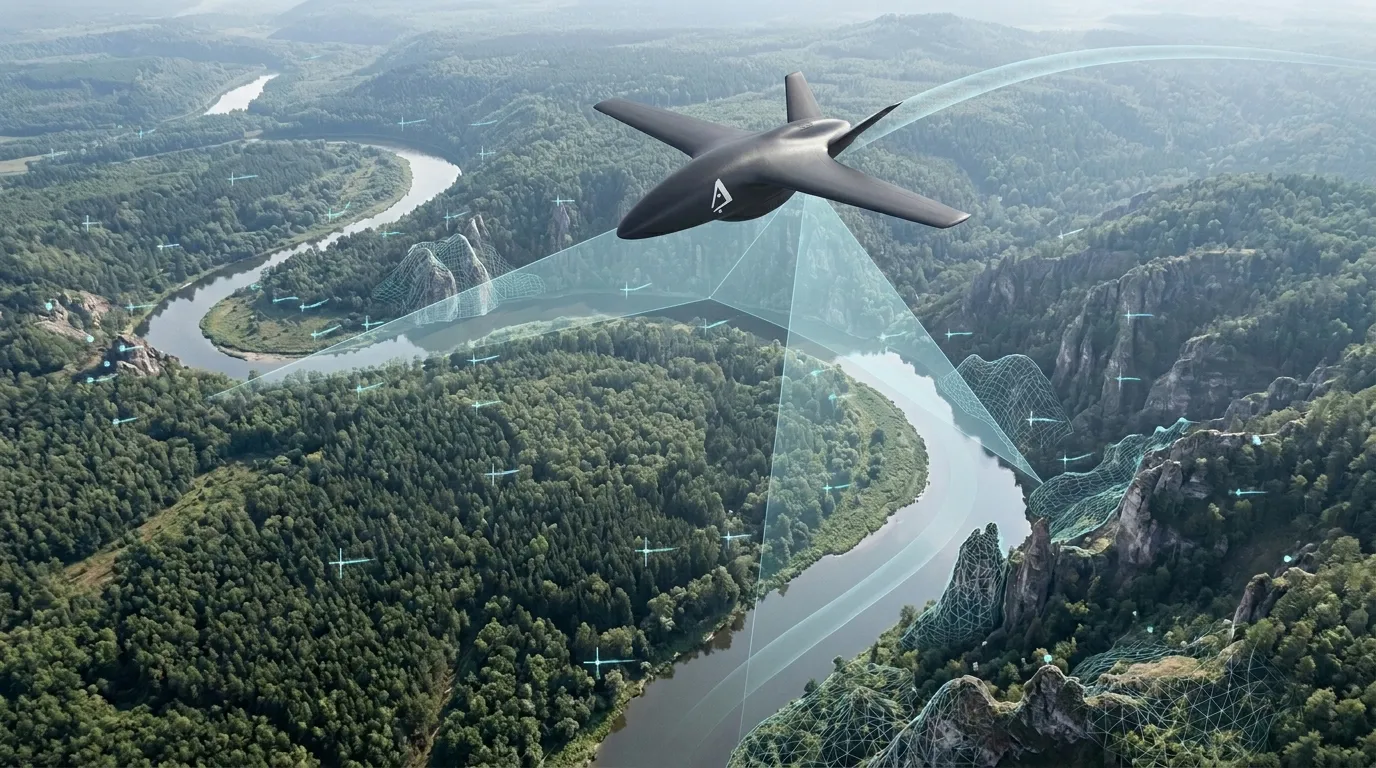
A large autonomous group has an important advantage over a single device: different participants observe the same situation from different points and can use different sensor systems.
However, the real value of such distributed surveillance only comes when the information captured becomes part of the big picture.
W-State Topology provides an architectural framework for reconciling such observations at the group level. The device gets the opportunity to act taking into account not only its own local perception, but also the available collective state.
For research and monitoring tasks, this allows you to significantly expand the scope of observation while maintaining the connectivity of the actions of multiple autonomous platforms.
Engineering Application
W-State Topology is focused on tasks where increasing the number of autonomous participants should truly expand the capabilities of the system, and not just increase the number of independently operating devices.
These scenarios include:
- distributed exploration of large areas;
- joint observation of objects and processes;
- coordination of multiple sensor platforms;
- dynamic distribution of tasks within the group;
- work with changing composition of the autonomous system;
- missions that require scaling from a small group to a large swarm;
- long-term autonomous operation without a permanent control center.
The AERIS approach
AERIS does not view a swarm as a mechanical union of a large number of unmanned vehicles. The main research interest is to create a system for which collective behavior is an independent level of organization.
W-State Topology forms a distributed coordination architecture that can work as the number of participants grows, their position changes, and functions are redistributed within the group.
Scaling is of particular importance. The larger an autonomous system becomes, the more important is the ability to maintain consistency without one participant becoming the permanent decision-making center.