



Featured article
How NEXUS connects perception, memory and forecasting across robots in a distributed reasoning process, from assessing a situation to coordinated action.
In this article
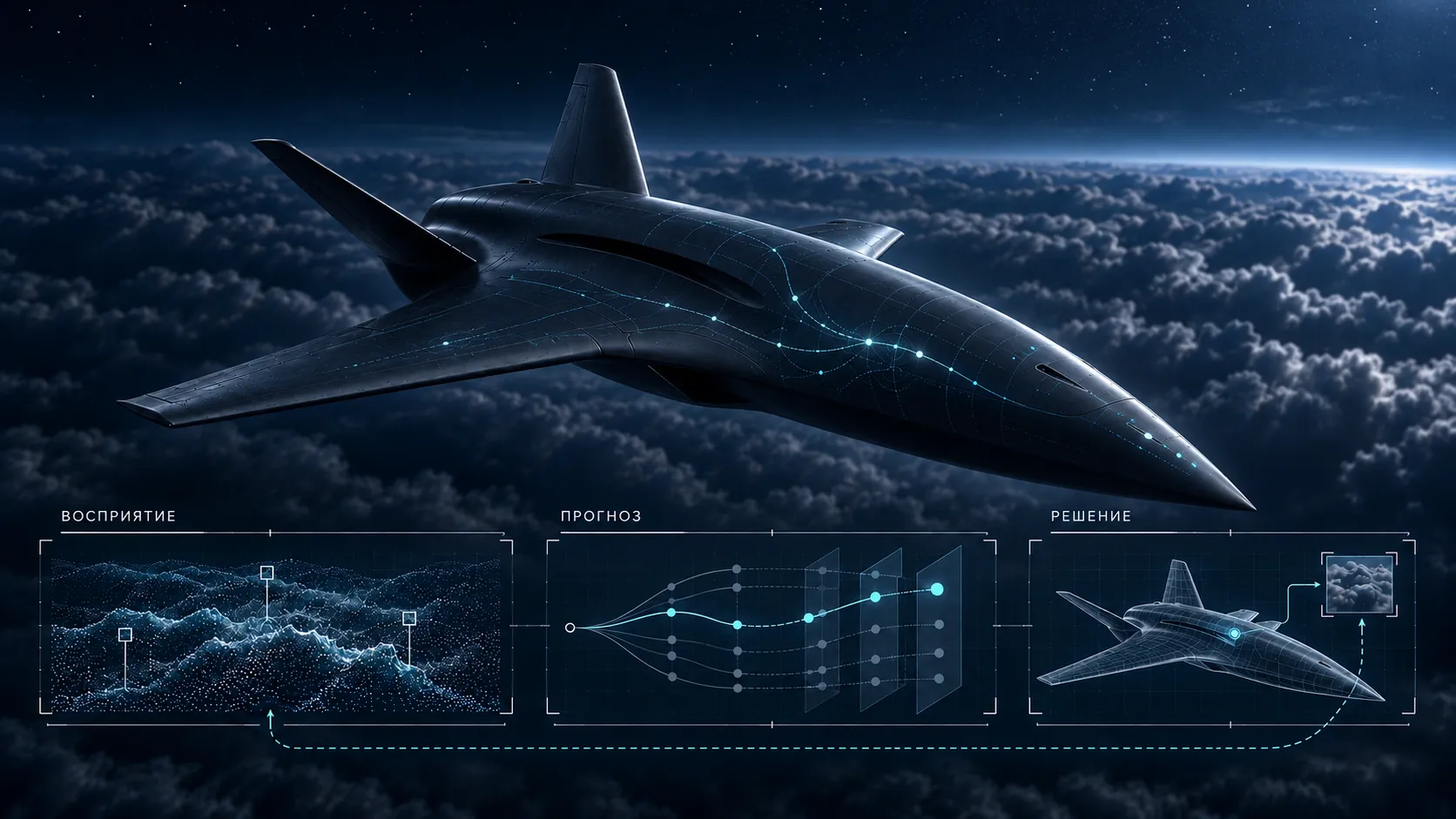
AERIS F³ is an AI pilot under development for AERIS autonomous robots. It combines forecasting, strategic planning and control of immediate actions. Before selecting a manoeuvre, the system evaluates how the situation, the aircraft's condition and its ability to continue the mission may change.
In autonomous flight, every decision changes the conditions for the next one. A course correction affects energy use and the availability of observations; a change in speed affects control margins and reaction time; an additional measurement consumes resources but may change the route selected. F³ considers these relationships together. Its forecast covers both the evolving situation and the consequences of the aircraft's own actions.
F³ is built around multi-scenario forecasting: each candidate action is assessed in terms of aircraft motion, changing external conditions, resource consumption and information availability. Multiple scenarios arise from the combination of different actions and different hypotheses about how the situation will develop. Both dimensions matter: the same command can produce different outcomes, while different commands can create fundamentally different conditions for continuing the mission.
The forecast is organised as an interconnected field of alternatives. Each branch contains a sequence of expected states and retains information about the actions and initial conditions that lead to them. Uncertainty and feasibility estimates accompany each state. Two alternatives with similar final positions may therefore have different value: they leave the aircraft with different energy reserves, control margins and ways to complete the task.
Here, k is a candidate course of action, j is a model hypothesis, and τ is the forecast horizon; ẑ denotes the expected state, 𝓤 uncertainty, and 𝓒 the conditions for admissibility and resource feasibility. This notation shows the information required to compare alternatives.
Promising continuations are retained between planning cycles. New measurements refine their assessment, change their priority or make a continuation inapplicable. This continuity connects individual commands to a longer-term objective: each recalculation considers the mission direction already selected and checks whether the grounds for continuing it remain valid.
The near horizon describes the immediate response to control inputs. The longer horizon allows delayed consequences to be assessed: access to the next mission segment, changes in resources, and the conditions for returning or completing the task. The influence of a long-range forecast depends on its age, uncertainty and consistency with the current plan.
Onboard data arrives asynchronously. Measurements differ in update frequency, latency and field of observation; some characteristics are available only as model-based estimates. Decisions depend on each signal's value, when it was obtained and the basis for trusting it.
F³ uses a recurrent representation of history: successive observations are linked to the actions actually executed. This context allows process dynamics, such as changes in the aircraft's response to control inputs, to inform the next forecast. The external environment is considered together with the robot's own state.
In this representation, x describes motion, e external conditions, r physical resources and control capabilities, o the availability and quality of observations, and c the computational state. Missing information remains explicit: a measured quantity, a calculated estimate and an unknown value carry different status when an action is selected.
State transitions are estimated by an ensemble of learned dynamics models. The models receive a shared causal context and a proposed control input; disagreement between their predictions informs confidence estimates. Specialised models refine residual errors within conditions for which their applicability has been validated.
Decision-making operates at two timescales. The strategic level selects a mission continuation: moving towards the task area, changing the approach, gathering information or proceeding to a predefined mission termination. The immediate policy produces an action that reflects the latest observations and can be executed now.
The strategy defines the purpose of a command sequence and its completion conditions. It is retained while new data supports its feasibility and usefulness. As circumstances change, the pilot revises the continuation while preserving the mission objective and explicit rules for transitions between operating modes.
Selection uses a sequence of constraint checks. Safety admissibility is considered first, followed by physical and resource feasibility, then the remaining opportunities for correction and mission completion. The surviving alternatives are assessed for progress towards the objective, cost, uncertainty and the expected value of acquired data. High task utility cannot compensate for violating a mandatory constraint.
Separating these levels allows long-term consequences to be considered without waiting for every long-range calculation to finish. The immediate action relies on current information; strategic estimates are used within their period of validity. After a command is executed, both assessments are updated against the observed result.
Whether the next point is reachable depends on the condition in which the aircraft will arrive. In F³, this part of planning is handled by Future Self, a forecast of the robot's future resources and capabilities. It connects motion with energy, available control authority, observation conditions and computational readiness.
| What is assessed | What changes in the forecast | How it affects the decision |
|---|---|---|
| Motion | Position, velocity, orientation and response to control inputs | Reachability of the next segment and admissibility of the next manoeuvre |
| Energy and power | Consumption, remaining resources, available power and power supply constraints | Ability to continue and complete the mission |
| Control authority | Available control range given the condition of the actuators | Correction margin and physical feasibility of the action |
| Observation | Expected availability, freshness and information value of measurements | Ability to distinguish significant changes in the situation |
| Computation | Analysis time and available onboard computing resources | Readiness of the next decision by the required time |
These relationships are considered over time. Higher power demand changes energy consumption and power supply constraints; actuator condition determines the available correction range; thermal estimates account for available measurements and a heat-transfer model. Each channel preserves the distinction between known state and a calculated hypothesis.
A separate criterion is preserving the ability to continue. The pilot assesses whether the selected manoeuvre will leave enough space and resources to change the route, restore an admissible operating state or complete the mission. The margin for subsequent decisions therefore becomes part of the current action's assessment.
Physics-based resource calculations and learned estimates of future capabilities serve different roles. Their reliability is evaluated separately. The learned estimate helps rank admissible alternatives within validated operating conditions.
A forecast includes an assessment of how robust the expected outcome is. Variability in the environment and measurements produces aleatoric uncertainty. Limitations in data and models produce epistemic uncertainty. Ensemble disagreement is an important signal for the latter: agreement and conflict between models call for different interpretations of the result.
Confidence also depends on the freshness of input data, indications of conditions outside the known operating domain and the accuracy of previous predictions. These factors influence the assessment of continuations. If uncertainty concerns an outcome on which the mission's continued feasibility depends, it becomes a reason to reconsider the action or obtain more information.
Branch priority, hypothesis weight and the probability of a physical event retain distinct meanings. High estimated utility does not imply a high probability of success. Probability estimates require calibration: stated confidence is compared with the frequency of corresponding events in independent data.
An unknown outcome remains unknown until there is sufficient evidence to assess it. This is particularly important for resource constraints and actuator condition: a missing measurement must not create a false impression that no constraint exists.
Observation can be an action in the plan in its own right. If two hypotheses imply different decisions, a measurement that distinguishes between them has practical value. For example, better knowledge of an external disturbance may change the assessment of whether an approach to the task area is energetically feasible.
F³ compares the expected improvement in a decision with the cost of obtaining data: time, resource consumption and changes in sensor mode. Priority goes to information capable of changing a consequential mission decision. Reducing uncertainty is considered together with its implications for behaviour.
This calculation relies on a model of the expected observation. Its result remains a hypothesis until data is actually obtained. Acknowledgement of a command by a measurement system does not substitute for a measurement: channel readiness, the timestamp and the quality of the received signal are all considered.
After receiving the information, the pilot reassesses the associated continuations. Motion selection and observation selection thus form a single process: a manoeuvre changes data availability, and the data changes the next manoeuvre.
After an action is executed, F³ compares the expected state with the observed state. The comparison is tied to the command actually performed and the corresponding horizon. If the control input changes, a forecast for the original action is not treated as a direct prediction of the outcome of a different manoeuvre.
Discrepancy analysis distinguishes measurement error or staleness, timing misalignment, numerical problems and changes in the object's dynamics. The cause determines the response: excluding an unreliable signal, reducing forecast confidence, revising the continuation or entering a predefined restricted mode.
Recurring deviations inform the preparation of specialised models. At the same time, feedback changes the current assessment of alternatives. This connects model quality to its actual role in control: what matters is the errors capable of changing a decision and the conditions in which they arise.
For an autonomous pilot, computation time is part of the control problem. Increasing the number of alternatives or the forecast depth requires memory and computing resources. A result that arrives too late may describe a situation that has already changed.
F³ adjusts the amount of analysis to the available budget: observed computation time, memory and information about the onboard platform's condition. More detailed calculation is performed within permitted limits. When load rises or deadlines are missed, the system restricts the available computational modes.
Long-range estimates can be produced separately from the immediate decision. Their age and consistency with the active control option are checked before use. This allows the current control cycle to continue while incorporating the results of deeper analysis as they become available.
Preparing F³ involves several connected tasks. Dynamics models learn to describe transitions from the available history and an action to the subsequent state. The behavioural policy learns to select actions based on their expected consequences. Specialised models refine predictions in particular operating regimes.
Dynamics training uses observed state transitions. Reinforcement learning connects policy selection with outcome assessment; an actor–critic mechanism separates action generation from estimation of expected utility. Components have separate training objectives and update procedures because prediction accuracy and control quality require different criteria.
Each training example preserves the causal sequence: information available before the decision, the action executed and the result obtained. The future state is used as a target, while the input history is limited to information that could genuinely have been known at the time of selection.
Data is split by episode and scenario origin. Nearby windows from the same flight and variations derived from a common source scenario are treated as related data. This is necessary for the final evaluation to reflect transfer to independent conditions.
A new specialised skill progresses from candidate to validated configuration. It is compared with the current model, its effects on related tasks are assessed, and only then is it included in a coordinated set. Model identities and the ability to revert to the previous configuration are retained. Improvements in a particular forecast are evaluated together with changes in the pilot's behaviour.
A selected action undergoes a separate check before being passed for execution. This check concerns the aircraft's actual state: measurement freshness, command validity, the sequence of control requests, available resources and the admissible motion envelope. Low-level stabilisation retains its own control loop.
The separation of authority is built into the system. Learned mechanisms generate and assess proposals; execution control checks their applicability against established constraints. A model's utility estimate cannot change the mandatory conditions for accepting a command.
If no admissible proposal is available or the required data is no longer current, predefined rules for restricted behaviour apply. This structure allows forecasting and skills to develop without giving a learned model authority to change execution boundaries.
Consider surveying an area while external conditions change. The pilot can continue directly, change its approach or first obtain an additional observation. Each option is assessed as a sequence of consequences.
| Option | Immediate result | What determines continued feasibility |
|---|---|---|
| Continue moving | Maintaining progress on the task | Increasing energy demand, uncertainty in aircraft response and the remaining correction margin |
| Change the approach | A different motion geometry | Observation quality, available control authority and resources for the next segment |
| Gather more information | Time and resources spent on a measurement | The likelihood of obtaining information that changes the next action selected |
If direct progress reduces the margin for subsequent correction, its assessment changes. If another approach improves observability and preserves resources, that is included in the comparison. If an unknown factor determines the difference between options, the pilot assesses whether another measurement is worthwhile.
After the selected action is executed, new data updates the forecast. This example illustrates the decision logic: selection depends on how the situation develops, the aircraft's capabilities and the conditions under which the next decision will be made.
Prediction and behaviour are evaluated at several levels. For dynamics models, position, velocity and orientation errors across different horizons matter. For uncertainty, the criteria include prediction-interval coverage and the agreement between stated confidence and observed events. Resource evaluation considers the accuracy of estimates for remaining energy, available power and control capabilities.
At mission level, criteria include task completion, constraint compliance, resource consumption and the outcome of the predefined mission termination. At the onboard execution level, they include latency distributions, missed deadlines, memory use and energy use. Average accuracy is considered alongside adverse cases in which an error can change the action selected.
The effects of individual mechanisms are established by controlled comparisons between configurations using the same scenarios and budgets. This allows the contribution of the ensemble, resource forecasting, retained continuations or active observation to be evaluated. The independent unit of analysis is an episode or a scenario family; results are interpreted with variation and data dependence in mind.
F³ extends onboard planning to include the conditions for continuing the task. The aircraft assesses what a selected action will lead to, which capabilities will remain afterwards and what information will be needed for the next decision. This defines the pilot's development: from predicting individual state transitions to coordinated management of mission continuation.
The technology is integrated into AERIS robots and is available exclusively as part of those robots. Physical model parameters, execution constraints and computational modes are matched to the specific aircraft.
Featured article
How NEXUS connects perception, memory and forecasting across robots in a distributed reasoning process, from assessing a situation to coordinated action.

Featured article
Autonomous navigation reduces manual operator workload when route planning, sensors, state monitoring and contingency modes are designed together.