




Featured article
Autonomous navigation reduces manual operator workload when route planning, sensors, state monitoring and contingency modes are designed together.
In this article

AERIS NEXUS is the collective intelligence AERIS is developing for its robotic systems. Perception, memory, forecasting and decision-making are distributed across the robots. Each participant carries part of the computational structure and contributes to the behaviour of the group.
In NEXUS, collective intelligence has a specific engineering meaning. Participants' states become inputs to one another's decisions: an observation by one robot changes the context available to the group; that context influences the evaluation of possible actions; and the outcome of execution feeds back into memory and learning. Collaboration takes place within the reasoning process, before robots are assigned roles or directions of movement.
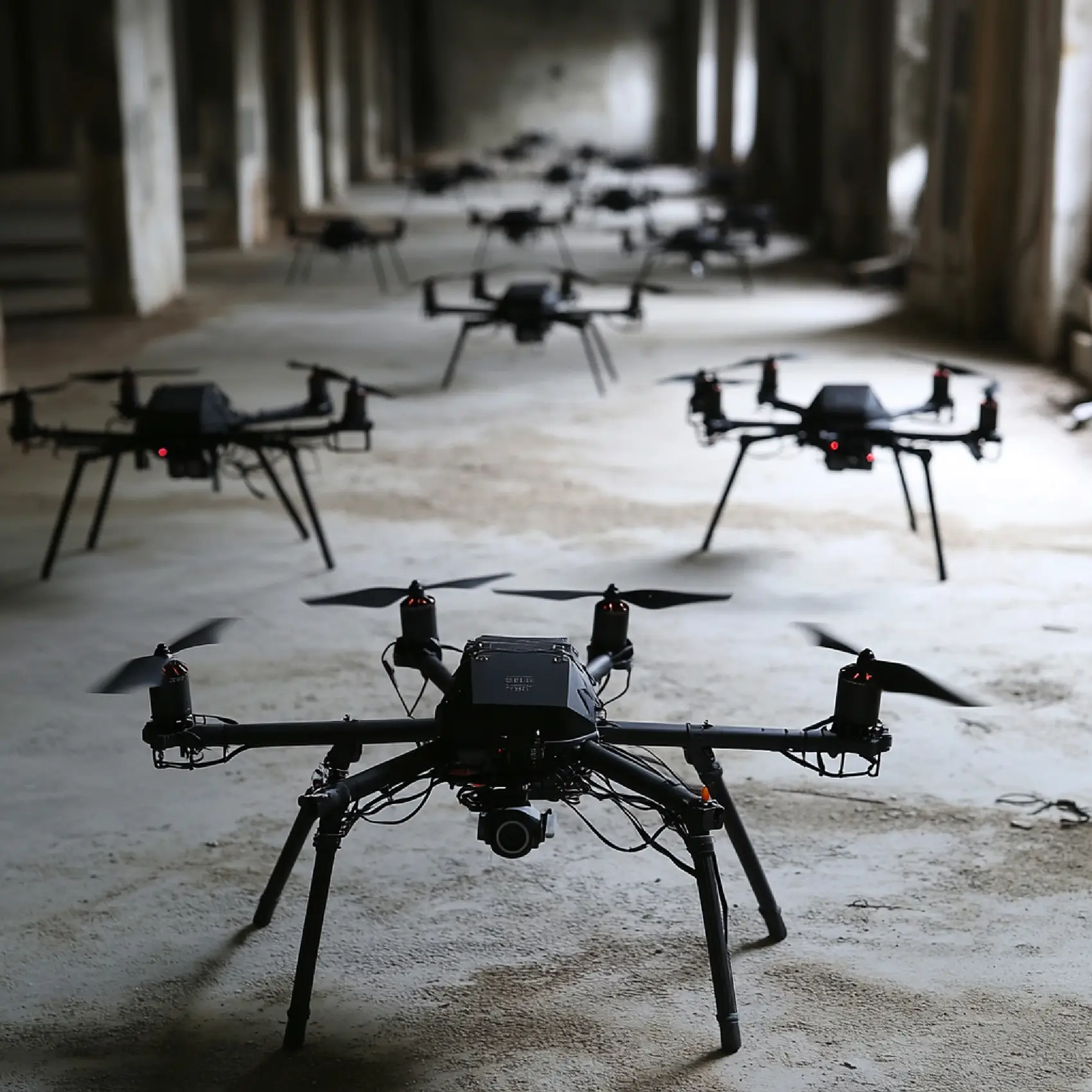
In swarm robotics, this principle connects multiple physical platforms into an evolving cognitive system. It perceives the environment from different viewpoints, evaluates possible future scenarios and allocates actions according to the shared task and the capabilities of individual robots.
The basic element of NEXUS is the QCM, or Quantum Cognitive Module. It contains a neural representation of the current situation, a complex-valued register of alternatives, a local share of collective memory and computational resources. Through connections with other modules, its state contributes to the collective context.
Participants are connected by a dynamic graph. Its vertices represent available modules, while its edges represent permitted directions of interaction. The graph changes with the availability of robots and communication links. A neural attention mechanism determines how available states contribute to the current choice; interactions between registers change the distribution of the alternatives under consideration.
Swarm intelligence emerges through the mutual influence of states. A robot's decision depends on its own position, the states of other participants, retained experience and the consequences of possible actions. A change in a significant observation can affect forecasting, role allocation and the subsequent behaviour of several robots.
The system does not require every decision to pass through a central computer. Cognitive processing takes place on the nodes themselves. Each module operates within the context actually available to it: the time, provenance and compatibility of received states determine whether and how they can be used.
The trainable core is based on QSI-SS, or Quantum Swarm Intelligence with State Superposition. Neural encoding, the representation of alternatives and their interactions across nodes are combined in a single computational process. Neural network parameters and phase transformations are trained jointly.
A module's register contains complex amplitudes representing possible alternatives. The magnitude of an amplitude contributes to the distribution, while its phase determines how it interacts with other contributions. Combining states therefore accounts for both the significance of individual alternatives and the relationships between them. Phase mixing can reinforce some combinations and attenuate others.
Pairwise factors describe interactions between the alternatives of two participants. This brings dependencies between actions into the selection process: the value of one robot's next step changes with the expected behaviour of another. An additional anti-state mechanism learns to suppress particular register components; a separate participation estimate connects the collective state to task allocation.
The register's mathematical basis is the superposition and interference of complex amplitudes. In the software core, these operations run on conventional processors. Communication links between robots carry state representations on which subsequent transformations are performed.
The state of a single module can be written as follows to describe the distributed structure:
Here, h is the neural representation of the situation, ψ is the register of alternatives, M is the available memory and b is the computational budget; the index i identifies the participant. Collective behaviour emerges from interactions between these states over the current communication graph. This notation describes the components of a cognitive node; the trainable model defines the specific transformations.
To select an action, NEXUS constructs a field of possible future scenarios. It connects alternative actions to expected motion, resource consumption, observation availability and the conditions for continuing the mission. Several models evaluate how the situation may develop; disagreement between their predictions is retained as information about uncertainty.
Computation of this field is distributed among participants. A node receives a bounded portion of the task, computes possible continuations and returns the result with identifiers for the original request, model and alternatives. A robot can simultaneously request a forecast for its own next action and compute part of the field required by another participant.
Once the available results have been combined, alternatives are evaluated within a consistent context. The assessment considers expected outcomes, feasibility, resource state and differences between model estimates. Incompleteness remains explicit: a missing response leaves some alternatives unevaluated, while an expired result is excluded from the current decision.
The depth and extent of computation are matched to the available processors, their workload and the time within which a decision remains useful. In a rapidly changing situation, a forecast matters if it arrives in time to influence action. Expanding the computation is worthwhile while additional alternatives help distinguish the consequences before that deadline.
Distributed computation thus becomes part of NEXUS reasoning: several physical devices contribute to constructing the space of alternatives from which subsequent behaviour is selected.
Fleet Memory connects individual observations over time. Each record retains its author, acquisition time, association with an object or event and information about reliability. Replicas are distributed across nodes, allowing knowledge already shared to remain available after the robot that acquired it disconnects.
Retransmitting a record preserves its identity. Ten copies of one observation provide the same evidence; a new measurement from another viewpoint contributes a different source of information. This distinction is fundamental to collective intelligence: disseminating information and accumulating independent evidence serve different purposes.
Memory also retains conflicting hypotheses. If two robots describe a situation differently, the discrepancy can motivate an additional observation. Planning then receives a concrete information question: which measurement would help distinguish the hypotheses and change the choice of action?
Operational validity and long-term history are kept separate. Information can remain in the experience log after the period during which it is valid for guiding decisions. When communication is restored, participants exchange retained records while checking their provenance and timestamps.
Spatially separated robots observe the environment from different positions and under different conditions. For NEXUS, what matters is the contribution each observation makes to the current task: whether it refines an object's position, distinguishes competing explanations or provides grounds for changing a route or reassigning a role.
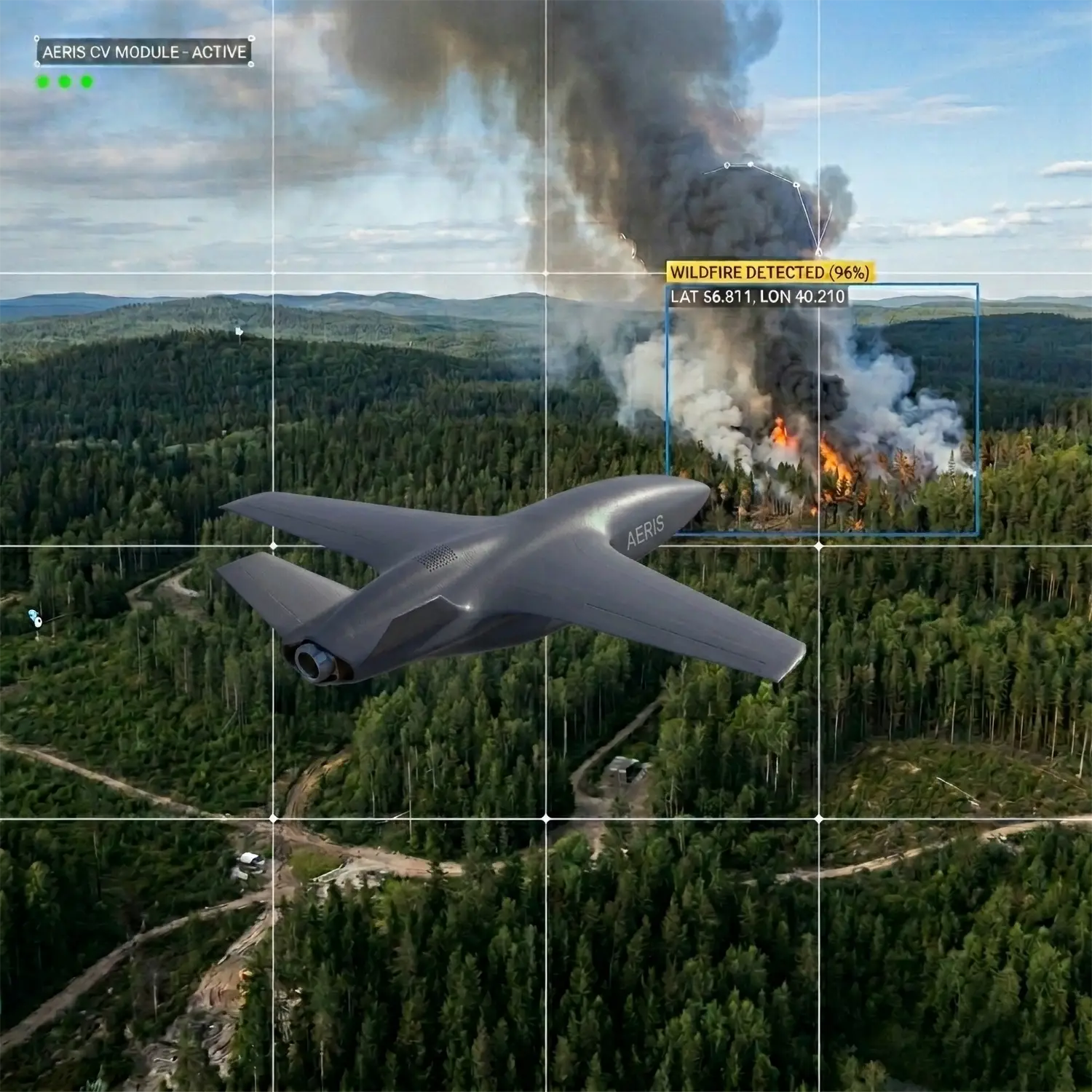
Visual context is transmitted as structured information about events and tracked objects. Alongside the description, it retains source, frame, track and model identifiers, timestamps and references to the evidence supporting the inference. This exchange incorporates visual analysis into collective memory without requiring a continuous video stream to every participant.
A semantic inference retains its status as a hypothesis. For example, a report of a possible object may trigger an additional survey, while its interpretation is checked against geometric data and other observations. The system maintains the distinction between what has been measured, what has been inferred and what still needs clarification.
Collective attention also shapes role allocation. A robot in a suitable position with sufficient available resources can be tasked with resolving uncertainty while other participants continue the survey. The need for information therefore influences the group's physical actions.
A mission is represented as a task graph with dependencies, priorities and completion conditions. This expresses the sequence of work: first collect information about an area, then perform an additional survey, and proceed to a dependent task only after the result has been confirmed.
Role allocation considers a robot's capabilities, available resources, position, observation quality and neural utility estimates. The operational process includes mapping, observation and communication-relay roles. When group membership changes, assignments are recalculated for the remaining participants.
Reaching a coordinate and completing a task are tracked separately. A survey may require a period of observation and verified measurements. Completion is recorded against a specific mission plan once the defined conditions have been checked. Persisted progress allows work to resume after a restart without losing results already accepted.
| Process | What NEXUS considers | How it influences behaviour |
|---|---|---|
| Perception | Participants' observations, provenance, timing and differences between hypotheses | Determines what information is available and what requires clarification |
| Forecasting | Alternative actions, consequences, resources and uncertainty | Develops options for continuing the mission |
| Role allocation | Priorities, dependencies, robot capabilities and utility estimates | Assigns robots to tasks and sets individual objectives |
| Feedback | Verified execution, measured outcomes and deviations from predictions | Updates memory, mission progress and training material |
Observation, forecasting and action are interconnected in this cycle. New information changes the assessment of alternatives; the chosen action changes the observer's position and the information available to it; the resulting outcome becomes part of the next decision.
NEXUS develops the collective layer of intelligence, while the AERIS F³ AI pilot connects forecasting and action selection to the capabilities of an individual robot. Their interaction covers motion models, future resource estimates, the ranking of alternatives and the validation of proposed behaviour. The robot's physical profile defines the conditions under which those assessments are meaningful.
This division of responsibilities allows collective intelligence to shape coordinated group behaviour while each robot retains local responsibility for execution. A proposed movement is checked against the current state, control limits and available resources. The onboard stabilisation loop operates independently of the completion of network computations.
Rapid changes are handled by NeuroReflex Fabric, a local event-driven layer. It processes events at several timescales to distinguish brief disturbances from persistent trends. Separating response times in this way combines distributed analysis of consequences with an immediate response to changes in the robot's state.
The physical profile, hardware interfaces and computational budget are considered separately. Replacing a processor changes the amount of computation available; changing the robot's dynamics requires a corresponding motion model. This creates an explicit interface between collective mechanisms and the characteristics of the physical platform.
Connecting an authorised, compatible module expands the active graph. Its states enter cognitive interactions, its observations enter memory and its computational capacity contributes to the forecasting workload. The number of participants is not encoded as a fixed list within the model's weights.
The value of an additional robot depends on its contribution: another viewpoint, access to a required area or the ability to compute continuations that have not yet been considered. The development of collective intelligence therefore depends on the diversity and quality of available experience, together with the resources to process it.
When a participant is lost, its expired state is removed from active interactions, the set of available processors is revised and its tasks are reassigned. The robots' local mechanisms continue operating. Knowledge already shared remains with the participants that received it, subject to retention and validity rules.
A network partition limits the collective context available to each participant. Separated groups make decisions using the information they have; after reconnection, exchanges allow retained information to be reconciled. The dependence of a decision on the available topology is explicit, alongside deadlines, incomplete information and possible state discrepancies.
The NEXUS learning process connects individual choices to group outcomes. Cooperative reinforcement learning evaluates progress towards the shared mission, accounting for time and constraints. It can therefore shape behaviour in which an action's utility is determined by its contribution to the collective task.
Neural representations, phase parameters, mechanisms for interaction between nodes and the selection of behavioural branches are updated jointly. Training covers the dependencies through which participants' states influence one another. Physical predictors have their own training process and remain tied to the robot's model.
Accumulating experience requires a causal connection between a proposal, its actual execution and the measured outcome. This makes it possible to compare predictions with results, identify residual errors and construct examples for further training. Local microcircuits can accumulate experience of characteristic responses and share prepared results with other nodes.
Sharing experience and approving an updated model are separate processes. A candidate model retains its provenance, undergoes independent evaluation and is introduced under controlled conditions with a rollback option. Onboard execution uses a prepared model and does not require a training server in every decision cycle.
Distributed reasoning requires a shared interpretation of exchanged states. NEXUS therefore checks a participant's mission membership, permissions, model compatibility and message freshness. States produced by incompatible models are excluded from neural mixing, while admissible observations may retain independent informational value.
Exchanges are protected by encryption, and signatures authenticate the provenance of transmitted records. Duplicate delivery, out-of-order messages and expiry are handled before data enters the operational context. A signature identifies the message's author; assessing the reliability of an observation remains a separate task involving perception and the comparison of evidence.
These rules maintain semantic consistency: participants must understand the time, source and model to which information relates before it influences a collective choice.
Consider a mission to survey a large area. This example illustrates how the mechanisms interact. The mission graph defines survey areas, priorities and observation-completion conditions. The collective state accounts for robot positions, available resources and information about which areas have already been examined.
One participant detects an ambiguous change in the environment. A record enters memory with its source and timestamp, retaining its status as a hypothesis. An additional observation task is created to resolve the uncertainty. Selecting a robot for that task takes account of position, sensor capabilities and remaining resources; forecasting evaluates the consequences of a change of direction and the conditions for continuing the mission.
Other nodes contribute to computing possible continuations. New results influence the choice of behaviour, and the assigned robot examines the situation from another viewpoint. The resulting information changes the collective context and allows dependent tasks to proceed. Roles are reassigned when necessary.
In this sequence, collective intelligence operates as a closed loop: observe, compare, forecast, allocate action and retain the outcome. Physically separated robots contribute to different parts of a single problem-solving process.
The engineering value of NEXUS lies in the connection between distributed cognitive state and group behaviour. Perception supplies evidence for decisions, memory preserves experience and contradictions, forecasting reveals consequences, and joint learning adjusts the interactions from which collective decisions emerge.
Evaluation must consider mission outcomes, the value of additional observations, decision latency, resource consumption and continuity of operation as communication conditions change. The contribution of each mechanism under comparable conditions and computational budgets is a separate subject of assessment. This connects model development to the quality of collective behaviour.
NEXUS is being developed as part of AERIS robotic systems. Its direction is collective intelligence that expands the available understanding of the environment, evaluates consequences from different viewpoints and turns that experience into coordinated action.
Featured article
Autonomous navigation reduces manual operator workload when route planning, sensors, state monitoring and contingency modes are designed together.

Featured article
A modular architecture allows sensors, computing hardware, software and mission scenarios to evolve without redesigning the entire UAS.